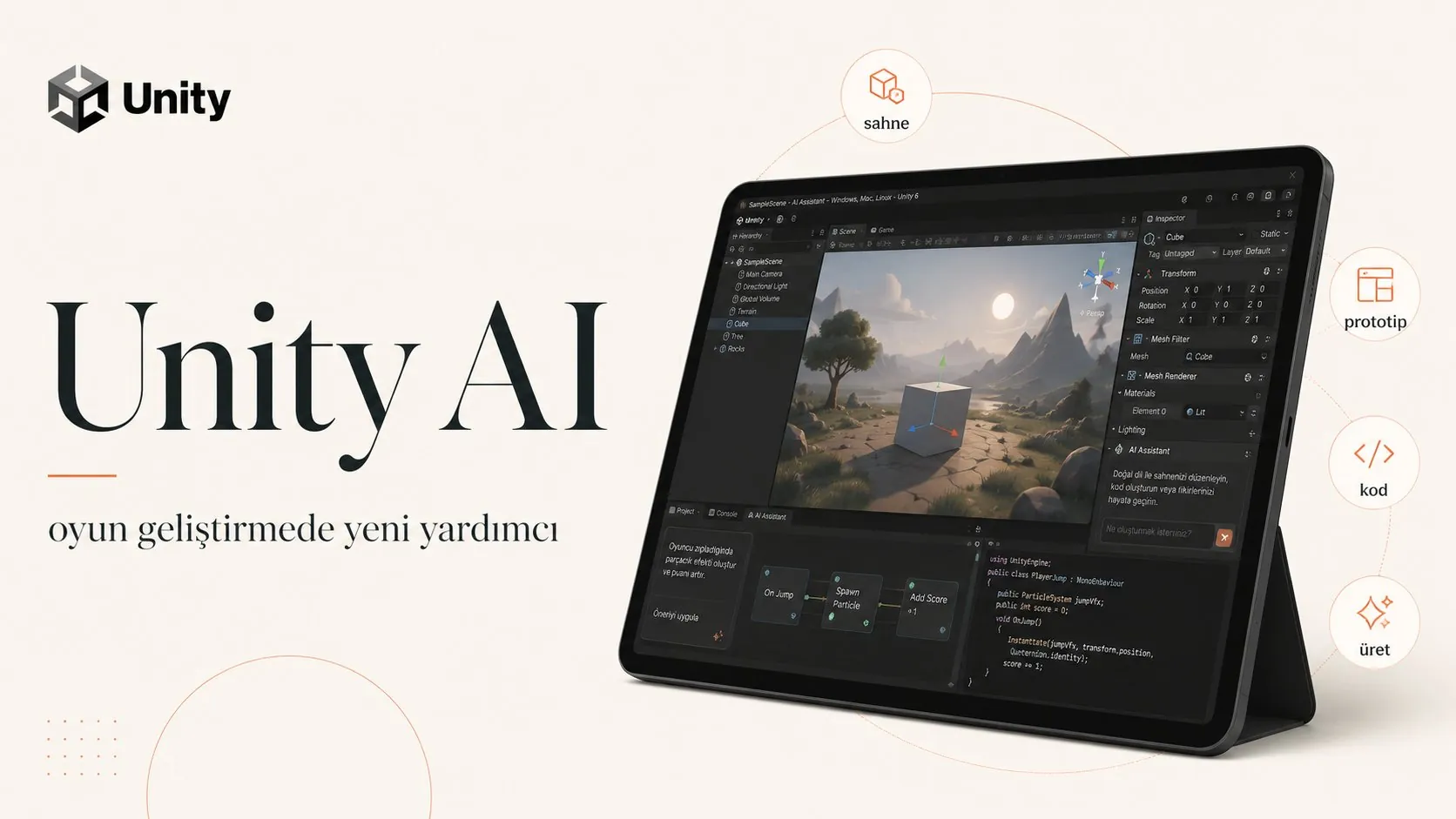
From the outside, making a game can look like writing code. In practice it is scene composition, character movement, lighting, sound, interface decisions, physics tests, and hundreds of small choices that only make sense together.
That is why Unity AI matters. It does not position artificial intelligence as a separate chat box that occasionally writes a script. It places AI closer to the engine itself, inside the production environment where the work actually happens.
What Unity AI actually changes
Unity AI is designed to help developers move through repetitive work faster. With an assistant, generators, AI Gateway, and MCP Server connections, the toolset points toward a future where the editor understands more of the project context.
That context is important. In a game engine, nothing stands alone. A script belongs to an object. An animation belongs to a system. A light, camera, UI element, and material all affect one another. AI becomes more useful when it can read those relationships instead of producing isolated snippets.
The biggest shift is the first draft
The strongest impact will probably be in early prototyping. A team with a small idea no longer has to spend days building placeholder systems before it can feel whether the idea works. Scene setup, rough interactions, starter scripts, and simple assets can move faster.
For small teams, that speed can be meaningful. Their shortage is rarely imagination. It is time, testing capacity, and the ability to try enough versions before energy runs out.
Can AI make a good game?
It can help make a game faster. It can support code, scene work, draft assets, and workflow decisions. But a good game is not only a technical output. It is rhythm, atmosphere, balance, tension, curiosity, and feeling.
AI can place a scene in front of you. A designer still has to know why that scene exists, what the player should feel there, and how it serves the larger experience.
Why creative studios should care
Unity AI is not only for game studios. Interactive brand experiences, product simulations, training tools, virtual showrooms, 3D websites, and augmented reality projects all live near the same territory.
For creative teams, this opens a practical field. Studios that can move from visual identity into interactive experience will become more valuable, because brands increasingly need systems people can touch, test, and move through.
The risk
The risk is confusing speed with quality. A scene produced quickly is not automatically a useful scene. Working code is not automatically maintainable code. A generated asset is not automatically right for the brand, the game, or the experience.
AI produces options. The human work is still deciding which option deserves to exist.